UWIN has previously established the “Legal Grand Slam” as an industry benchmark for the legal profession, which is designed to define the highest standard of excellence in legal services: a law firm or lawyer must demonstrate comprehensive recognition across the key assessment dimensions within the same core practice area and receive substantive endorsement from all leading authoritative ranking systems. Under UWIN’s assessment methodology, this benchmark is specifically defined as simultaneous recognition, within the same practice area, by the three core legal ranking systems—Chambers and Partners, The Legal 500, and LEGALBAND—whether through inclusion in their rankings or recognition at an equivalent tier.
The lists of Legal Grand Slam lists for other practice areas are available via the link below.⬇️

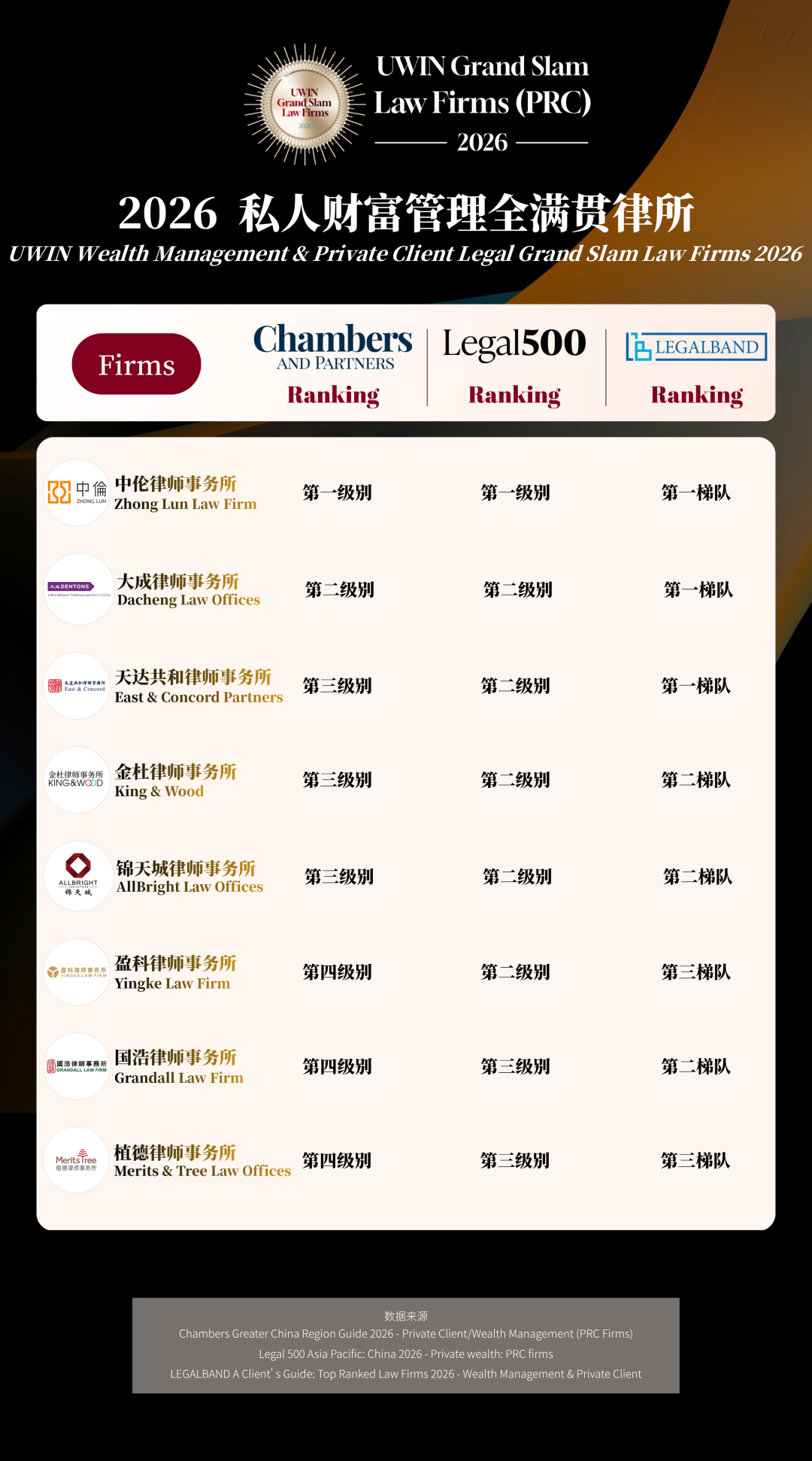
2026 私人财富管理全满贯律所
UWIN Wealth Management & Private
Legal Grand Slam Law Firms 2026
中伦律师事务所
Zhong Lun Law Firm
大成律师事务所
Dacheng Law Offices
天达共和律师事务所
East & Concord Partners
金杜律师事务所
King & Wood
锦天城律师事务所
AllBright Law Offices
盈科律师事务所
Yingke Law Firm
国浩律师事务所
Grandall Law Firm
植德律师事务所
Merits & Tree Law Offices


2026 私人财富管理全满贯律师
UWIN Wealth Management & Private
Legal Grand Slam Lawyers 2026
张钧
Jun Zhang
大成律师事务所
Dacheng Law Offices
贾明军
Mingjun Jia
中伦律师事务所
Zhong Lun Law Firm
林泽军
Zejun Lin
天达共和律师事务所
East & Concord Partners
倪勇军
Peter Ni
中伦律师事务所
Zhong Lun Law Firm
郭璇玲
Xuanling Guo
锦天城律师事务所
AllBright Law Offices
桂芳芳
Fangfang Gui
植德律师事务所
Merits & Tree Law Offices

For entrepreneurs whose wealth is closely tied to operating businesses, private wealth management legal services have long evolved beyond traditional dispute resolution. Today, such services must be closely aligned with core priorities, including wealth preservation, intergenerational succession, and cross-border compliance, forming a comprehensive legal support framework that spans the entire wealth management lifecycle. As demand for wealth preservation and intergenerational succession among affluent and high-net-worth individuals continues to grow, alongside the ongoing refinement of China's domestic regulatory framework and the increasing complexity of cross-border compliance, family trust structuring, separation of family and business risks, optimization of family governance, and cross-border wealth planning have emerged as key areas of legal practice. The value of legal services has consequently evolved from addressing isolated legal matters to designing comprehensive wealth structures that integrate legal, financial, and tax expertise.
Meanwhile, multidisciplinary and ecosystem-based collaboration has become standard practice in the mid- to high-end wealth management services market, with competition increasingly centered on depth of professional expertise and the ability to integrate resources across multiple disciplines. The industry continues to evolve toward greater specialization and more sophisticated, tailored service offerings. Against this backdrop, the Private Wealth Management Legal Grand Slam Law Firms and Lawyers 2026 represent leading practitioners distinguished by their established professional expertise and comprehensive service capabilities, serving as an important reference for entrepreneurs seeking specialized legal counsel for their private wealth management needs.
The assessment framework of the Chambers High Net Worth Guide reflects the increasing specialization of private wealth management legal services. The sector has developed into a multidimensional framework of specialized practice areas, distinguishing between domestic Chinese and international law firms while identifying two principal areas of practice: Family/Matrimonial Law and Private Wealth Planning. It also encompasses cross-border private wealth legal services from an offshore perspective, alongside dedicated categories for Private Wealth Disputes and legal services for Private Banks and Trust Companies. These increasingly differentiated classifications reflect clearer practice boundaries and more specialized assessment criteria. For entrepreneurs, this means that high-quality legal services are no longer defined by broad-based experience alone, but by the ability to deliver deep, specialized expertise tailored to specific wealth management needs.
Entrepreneurs' personal assets and the cash flows of their operating businesses are often deeply intertwined. When a business encounters debt defaults, failures to meet payment obligations under valuation adjustment mechanisms (VAMs), or major operational crises, the resulting risks can readily extend to family wealth through mechanisms such as unlimited joint and several liability and personal financial guarantees, potentially undermining the foundations of wealth accumulated over decades. Establishing legally compliant and effective mechanisms to separate business risks from personal and family assets is therefore a core competency of leading legal advisors and a fundamental priority for entrepreneurs seeking to preserve their wealth.
Greater China's Wealth Landscape and the Foundations of Demand for Private Wealth Legal Services
According to the UBS Global Wealth Report 2026, total personal wealth in Greater China reached US$95.9 trillion in 2025, accounting for 18.5% of global personal wealth, second only to the United States. The United States accounted for 35.7% of global personal wealth, with the two markets collectively representing more than half of the world's total personal wealth and forming the central pillars of the global wealth landscape. From a regional perspective, the Asia-Pacific region accounted for 32.8% of global wealth, with Greater China contributing nearly 60% of the region's total. This positions Greater China as the dominant wealth market in Asia-Pacific and underscores its strategic importance within the broader global private wealth management landscape.
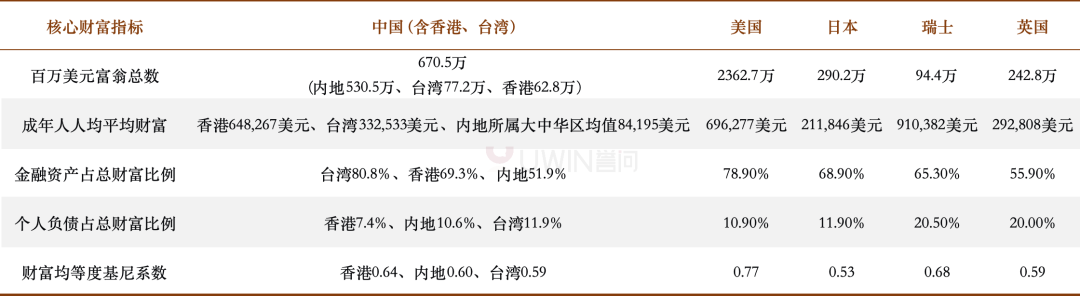
Greater China is home to 11.7% of the world's US-dollar millionaires. By individual market, Mainland China has more than 5.3 million US-dollar millionaires, while Taiwan and the Hong Kong Special Administrative Region (Hong Kong SAR) have approximately 772,000 and 628,000, respectively. In Mainland China, the number of individuals across wealth brackets ranging from US$5 million to US$100 million recorded compound annual growth rates (CAGRs) exceeding 20% between 2000 and 2025. Notably, the aggregate wealth of individuals in the US$50 million to US$100 million bracket grew at a CAGR of 30.9%. The rapid expansion of these upper-tier wealth segments has directly fueled demand for systematic wealth management and specialized legal services.
Asset composition within Greater China exhibits significant regional differences. Financial assets account for a substantial proportion of total wealth in Taiwan Province and Hong Kong SAR, at 80.8% and 69.3%, respectively. In Mainland China, financial assets represent 51.9% of total wealth, with non-financial assets continuing to play a significant role in household wealth portfolios. In terms of liabilities as a proportion of gross wealth, the corresponding figures stand at 11.9% for Taiwan Province, 10.6% for Mainland China, and 7.4% for Hong Kong SAR, indicating relatively moderate leverage levels across these markets. The diversity of asset classes and cross-regional wealth holdings means that entrepreneurs require legal services capable of addressing multiple dimensions, including domestic and international assets, operating businesses and financial investments, as well as existing wealth preservation and intergenerational succession.
Legal Service Requirements in the Family Office Sector
According to the UBS Global Family Office Report 2026, family offices in North Asia and Southeast Asia have demonstrated a strong willingness to adjust their asset allocations in response to an increasingly complex macroeconomic environment. As many as 71% of surveyed family offices in North Asia and 81% in Southeast Asia plan to modify their strategic asset allocations in 2026. For entrepreneurs who have established or are considering establishing family offices, every stage of portfolio restructuring requires robust legal support in regulatory compliance and wealth structuring.
In terms of portfolio composition, family offices in North Asia allocate 68% of their portfolios to traditional assets and 32% to alternative investments, reflecting a relatively conservative investment approach. Fixed income and equities account for 26% and 24%, respectively. By comparison, family offices in Southeast Asia allocate 62% to traditional assets and 38% to alternatives, demonstrating a relatively more growth-oriented investment strategy, with equities and private equity representing 31% and 20%, respectively. These differing allocation strategies entail distinct legal and regulatory risks, requiring legal service providers to possess specialized expertise across a broad range of asset classes.
To mitigate the risks associated with sudden regulatory changes in any single jurisdiction, family offices across Asia-Pacific have increasingly adopted multi-jurisdictional diversification strategies. In North Asia, none of the surveyed family offices hold their investable assets exclusively within a single jurisdiction, while 89% allocate assets across two to four jurisdictions. A similar diversification trend is evident in Southeast Asia, where 64% of family offices allocate assets across two to three jurisdictions, although 21% continue to operate under single-jurisdiction investment structures. Such multi-jurisdictional arrangements inevitably involve complex legal, regulatory, and tax coordination challenges, directly testing legal advisors' ability to integrate expertise and deliver coordinated services across jurisdictions.
Amid geopolitical tensions and concerns over sovereign debt, 60% of respondents in North Asia and 41% in Southeast Asia expect the US dollar's position as a reserve currency to weaken over the following 12 months. Nevertheless, actual investment allocations continue to demonstrate a clear preference for developed markets. Family offices in North Asia allocate 47% of their assets to North America, while the corresponding allocation among Southeast Asian family offices reaches 58%. This simultaneous reassessment of currency exposure and geographic allocation further underscores the importance of legally compliant and carefully structured private wealth arrangements.
In thematic investing, artificial intelligence (AI) has emerged as an area of strong consensus, with family offices in both regions demonstrating participation rates above the global average. As noted by the CEO of a Hong Kong-based family office cited in the report, institutions are investing in both the US and Chinese AI ecosystems. This strategy of leveraging domestic wealth foundations while pursuing investment opportunities across the two major technology markets requires legal service providers to possess global resource coordination capabilities and sophisticated cross-jurisdictional compliance planning expertise. These are precisely the core strengths that distinguish Legal Grand Slam-recognized law firms and lawyers.
Overall, as entrepreneurs' wealth management needs become increasingly diversified, complex, and cross-border in nature, the demands placed on legal service providers' comprehensive capabilities continue to rise. Selecting Legal Grand Slam-recognized legal counsel is, in essence, a decision to engage professionals who combine specialized expertise across the full spectrum of private wealth matters, multidisciplinary resource integration capabilities, and proven experience in coordinating legal services across multiple jurisdictions. Such capabilities are essential to addressing the complex and evolving needs of entrepreneurs throughout the entire lifecycle of business operations, family wealth preservation, and intergenerational succession.