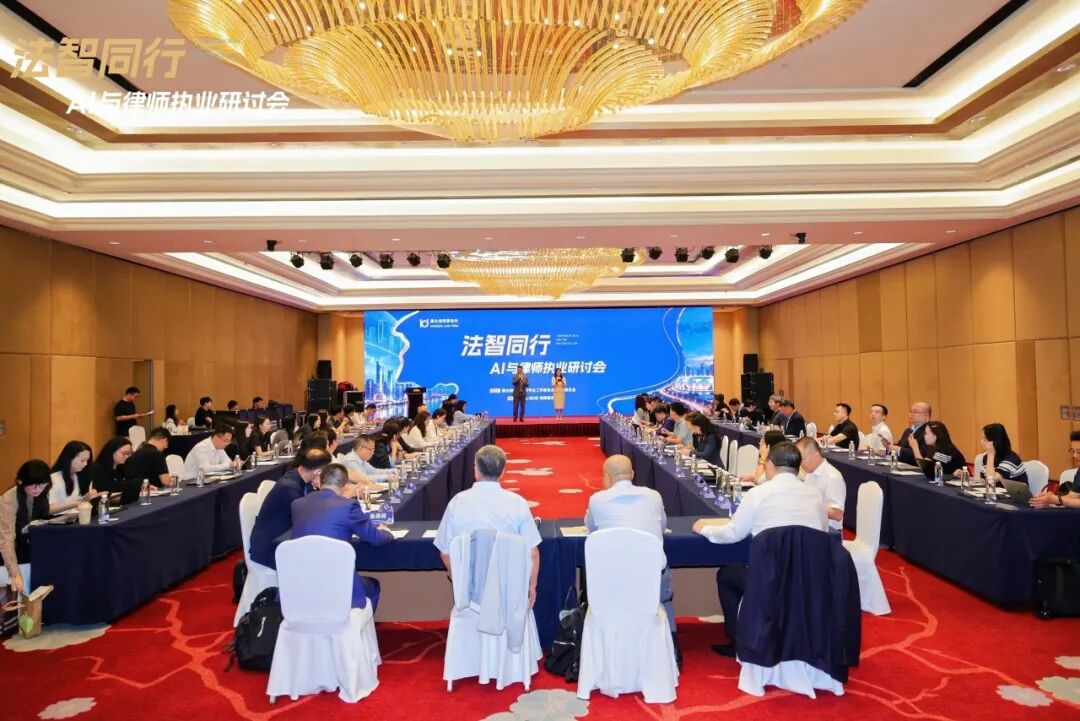
Recently, Kangda’s “Law and Intelligence Together” AI and Lawyer Practice Seminar was held in Hangzhou. The event was hosted by Kangda’s Specialized Working Committee and Risk Control Committee, organized by the Hangzhou office, and brought together nearly one hundred lawyers and corporate legal heads from offices across the country. Ms. Chong Wu, founder of UWIN Consultancy and advisor on brand strategy and business development in the legal industry, was invited to attend and shared her observations on competition in legal services and client trust under the title “When Everyone Has AI, Why Would Clients Still Choose You?”

From Tool Application to Organizational Capability
This seminar continued Kangda’s exploration of AI legal application conducted in multiple cities in 2026. Topics covered brand acquisition, case file processing, document desensitization, and knowledge asset building, and also introduced progress on AI operating guidelines.
These arrangements reflect Kangda’s sustained investment in technological change, while also touching on substantive issues in law firm management: how to turn individual application experience into capabilities that the organization can share, while safeguarding the boundaries of confidentiality, quality, and professional responsibility.
Access to AI tools is becoming increasingly convenient, yet incorporating them into reliable work processes requires long-term construction. By placing professional development and risk management on the same agenda, Kangda provides the industry with a noteworthy practical perspective: the depth of technology adoption is ultimately measured by changes in daily work.
As the Supply of Professional Expression Increases, Clients’ Judgment Costs May Not Decrease
Ms. Wu’s sharing further discussed the impact of technology popularization on the legal services market.
In the past, continuously producing professional content required considerable time investment. Today, AI has significantly lowered this threshold. However, an increase in content does not necessarily help clients make better choices. When articles from different lawyers all feature complete structures and professional wording, clients instead need to spend more effort discerning the real capabilities behind the expression.
UWIN Consultancy believes that the scarcity of ordinary professional expression is declining, and expression that can demonstrate experience and judgment therefore becomes more important.
Legal rules can be quickly organized, yet the trade-offs of interests, commercial constraints, and risk judgments in specific issues require lawyers to deeply understand their clients. The competitiveness of professional content thus depends on whether it can present a clear capability: facing the client’s situation, what the lawyer has seen, and how they judge.
This places higher demands on brand building. Without clear positioning, increasing publication frequency easily amplifies homogenization; only by continuously accumulating around specific industries and issues is there an opportunity to form a stable professional recognition.

Chong Wu, Founder of Uwin Consultancy and Advisor on Brand Strategy and Business Development in the Legal Industry
Trust Requires Verifiable Grounds
When choosing a lawyer, clients have always faced the problem that professional capabilities are difficult to fully assess in advance. The popularization of AI-generated content has made this issue even more prominent.
Search results, professional articles, and third-party evaluations may influence a client’s judgment before they first contact a lawyer. Brand building therefore needs to pay attention to the complete information environment: whether the professional positioning presented across different channels is consistent, whether relevant experience is verifiable, and whether external recognition has credibility and domain relevance.
Ms. Wu Chong pointed out that the significance of core awards, professional media, and high-quality case content lies in providing evaluable grounds that can be verified. Exposure can bring attention, but whether trust can be established still depends on whether this information is authentic, specific, and relevant to the client’s issues.
This exchange allowed UWIN Consultancy to get closer to the technology application practices of frontline lawyers and corporate counsel. For a consultancy that continuously studies brand and business development in the legal industry, these on-site discussions are also an important source for testing market judgments.
AI is changing the ways professional capabilities are expressed and conveyed. What lawyers need to consider is how to make the efficiency brought by technology ultimately support clients in recognizing them more accurately, and in having sufficient grounds to make a choice.